Multi-Tenant SaaS Platform
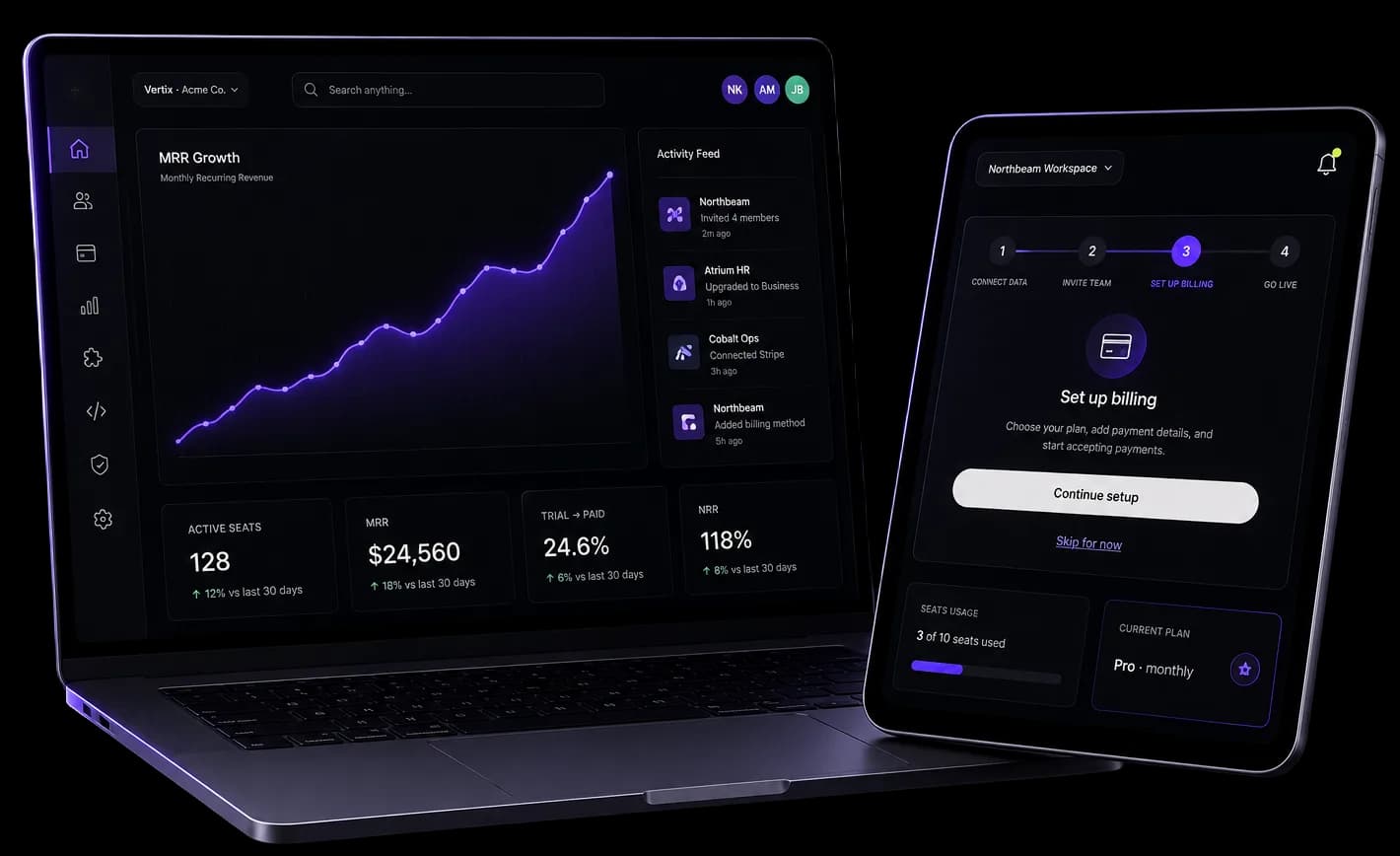
Row-level security or schema-per-tenant architecture designed from sprint one. Workspace isolation, role-based access, and tenant admin panels built as a foundation, not retrofitted.

Industries · SaaS & Startups
From MVP validation to enterprise-grade multi-tenant SaaS — IrenicTech builds scalable platforms engineered for subscriptions, users, billing, automation, and long-term growth. One senior in-house team from first spec to production launch, shipping AI-native by default. Built for UAE and MENA teams, delivered from our Sharjah base.


The gap
The shortcuts that let you ship fast in month one become the bottlenecks that stop you shipping in month twelve. These are the patterns we see in every discovery call.
Spaghetti architecture under a polished UI. When user count or feature count doubles, everything slows or breaks — and the rewrite clock starts.
Data isolation added as an afterthought means schema migrations, shared-table risks, and months of engineering to retrofit what should have been day-one design.
Bubble, Webflow, and Retool get you to launch fast — then lock you into their pricing model, their data schema, and their scalability ceiling as you grow.
Stripe is deceptively hard. Plan gating, usage metering, proration, dunning, and trial flows consume weeks of engineering time if billing is an afterthought.
Without proper observability, CI/CD, and infrastructure automation, dev time drains into deployments, hotfixes, and environment debugging instead of product.
Without AI-native signals wired into the data model, churn is spotted in the spreadsheet after the customer has already cancelled.
Looking for a specific capability? See all services we offer.
Custom vs off-the-shelf
No-code and low-code tools — Bubble, Webflow, Retool — get a product in front of users quickly. Here is what you give up as your platform grows.
No-code / low-code
IrenicTech custom
Multi-tenancy
Template-based shared tables or implicit isolation — data leaks are a constant risk at scale
Row-level security or schema-per-tenant designed from sprint one — data isolation is provable
Billing complexity
Plugin-dependent; custom plan logic, metering, and dunning require painful workarounds
Stripe integrated with plan gating, usage metering, trial flows, and dunning in the core build
AI integration
Bolt-on widgets behind third-party rate limits and vendor data policies
AI wired into your data model — churn prediction, RAG assistants, usage anomaly detection
Scalability ceiling
Platform ceiling you hit at scale; no predictable egress cost and no route around the vendor
Your infrastructure, your scale, your bills — no ceiling and no vendor chokehold
IP ownership
Logic lives in the platform; data export is limited and switching cost compounds with growth
Full code ownership from day one — repo, database, and all accounts in your name
Long-term cost
Per-seat or revenue-share fees that permanently compress margin as the business grows
One-time build cost; your infrastructure bill, under your control
What we build
Eight product categories covered by one senior team — from customer-facing SaaS products to internal ops tools to billing and cloud infrastructure. Every build is a custom SaaS engagement, not a configured template.

Row-level security or schema-per-tenant architecture designed from sprint one. Workspace isolation, role-based access, and tenant admin panels built as a foundation, not retrofitted.
Fixed-scope MVP that proves the model without creating a rewrite in month six. Core user flows, auth, billing, and a data model that survives the first pivot, shipped in 10–14 weeks.
Customer admin panels, ops dashboards, usage analytics, feature-flag consoles, and support tooling built for the teams running the platform, not just the customers using it.
REST or GraphQL APIs, webhooks, developer portals, and third-party integration layers — so your SaaS can become a platform other products build on.
Stripe and Paddle integrations with plan gating, seat-based billing, usage metering, free trials, upgrade flows, dunning, and MRR and ARR reporting dashboards.
Inherit an existing codebase, stabilise the highest-risk areas in the first sprint, then extend on a foundation you trust. Best for rescues, second-version rebuilds, and post-acquisition consolidation.
Churn prediction, RAG-backed in-app assistants, natural language search, automated onboarding, and usage anomaly detection — designed into the architecture, not dropped in as a widget.
CI/CD pipelines, containerised deployments, auto-scaling infrastructure, observability stacks, and security hardening — so the platform earns its SLA every day, not just on launch.
Row-level security or schema-per-tenant architecture designed from sprint one. Workspace isolation, role-based access, and tenant admin panels built as a foundation, not retrofitted.
Fixed-scope MVP that proves the model without creating a rewrite in month six. Core user flows, auth, billing, and a data model that survives the first pivot, shipped in 10–14 weeks.
Customer admin panels, ops dashboards, usage analytics, feature-flag consoles, and support tooling built for the teams running the platform, not just the customers using it.
REST or GraphQL APIs, webhooks, developer portals, and third-party integration layers — so your SaaS can become a platform other products build on.
Stripe and Paddle integrations with plan gating, seat-based billing, usage metering, free trials, upgrade flows, dunning, and MRR and ARR reporting dashboards.
Inherit an existing codebase, stabilise the highest-risk areas in the first sprint, then extend on a foundation you trust. Best for rescues, second-version rebuilds, and post-acquisition consolidation.
Churn prediction, RAG-backed in-app assistants, natural language search, automated onboarding, and usage anomaly detection — designed into the architecture, not dropped in as a widget.
CI/CD pipelines, containerised deployments, auto-scaling infrastructure, observability stacks, and security hardening — so the platform earns its SLA every day, not just on launch.
Features that ship
End users, ops teams, and product and revenue functions have different jobs. Each surface is designed for the person actually using it — not a shared dashboard pretending to serve everyone.
For end users
For ops & admin
For product & revenue
Case study
Unicare (unicarehub.com.au) · Full-stack platform — web, iOS, Android, AI, and infrastructure
Problem
NDIS and aged-care providers run their day-to-day on a stitched-together stack: rostering in one SaaS, case notes typed after shifts, incident reports in a shared inbox, and audit evidence assembled by hand at inspection time. The result is 30–40% of clinical and admin time lost to coordinating tools instead of caring for participants.
Approach
IrenicTech designed and shipped Unicare end-to-end — one operating platform across web, iOS, and Android with six tightly-integrated modules (Client Setup, Live Staff Dashboard, Emergency Alerts, Task & Workflow, Form Builder, and Appointments) plus a full AI suite: Isla the in-app assistant, AI monitoring and notifications, smart staff suggestions for appointments, AI-drafted incident responses, and voice-to-record case notes that turn a shift recording into a compliant case note in seconds. Multi-tenant white-label is built into the core, so every provider runs on their brand.
Outcome
Unicare cuts admin time by ~40% for NDIS providers, keeps every case note, incident, and participant interaction audit-ready by default, and frees staff to deliver participant-centred care instead of coordinating tools. The platform is live, shipped across web and both mobile stores, and powering hundreds of NDIS provider workflows today.
AI-native
Every SaaS product we ship gets the same AI lens, designed into the architecture from day one. These are the use cases we have shipped in production SaaS environments.
01 · Use case
Behavioural signals — login cadence, feature adoption, support volume — fed into a model that surfaces at-risk accounts weeks before they cancel, so CS can intervene while it still matters.
02 · Use case
Contextual in-app guidance that adapts to each user's role and progress, reducing time-to-value and support ticket volume in the first 30 days after signup.
03 · Use case
Let users ask questions of their own data in plain English. No SQL, no pivot tables — just an answer and a citation, grounded in their workspace context.
04 · Use case
Surface underused features to the right users at the right moment based on similar-account behaviour, increasing adoption depth and reducing churn risk.
05 · Use case
A grounded in-app assistant that answers product, billing, and policy questions from your documentation, with source citations — deflecting tier-1 tickets without hallucinating.
06 · Use case
Continuous monitoring of usage patterns surfaces spikes, drops, and outliers the moment they happen — so ops catches problems before customers report them.
These capabilities are available across all industries we build for. Explore our AI automation practice.
Security & compliance
SOC 2, GDPR, ISO 27001, CCPA — controls in the architecture, not added before an audit. Every release of your custom SaaS platform ships with the evidence trail already assembled.
SOC 2 Type II
Security, availability, processing integrity, confidentiality, and privacy controls with a full evidence trail, built into the platform from day one.
GDPR
EU personal data handling including lawful-basis tracking, data residency controls, right-to-erasure workflows, and privacy-by-design architecture.
ISO 27001
Information security management system — risk assessments, controls, and continuous improvement aligned to the international standard.
CCPA
California Consumer Privacy Act compliance: data inventory, opt-out flows, deletion rights, and disclosure obligations built into the data model.
OAuth 2.0 / OpenID Connect
Modern auth standards for SaaS APIs — short-lived tokens, scoped access, MFA-ready, and audit-friendly for enterprise SSO requirements.
RBAC & Zero Trust
Role-based access control with attribute-based extensions. Principle of least privilege enforced at every layer — API, data, and UI.
Encryption at rest + in transit
AES-256 at rest, TLS 1.3 in transit, and key management practices that satisfy SOC 2 and enterprise procurement checklists out of the box.
Penetration testing
Structured pen-test cycles aligned with OWASP Top 10, with remediation tracked through the same sprint cadence as product features.
BAA / DPA available on request — we carry our own agreements and sign yours.


How we work
SaaS founders want to know what month one looks like before committing. Here is the exact sequence from discovery sprint through production launch and steady-state SLA.
01
Map user personas, data model, pricing tiers, multi-tenancy strategy, and technical constraints. Delivers a written architecture RFC and a fixed-scope estimate.
02
Multi-tenant schema, auth strategy, billing configuration, CI/CD pipeline, and observability stack designed before a line of product code is written.
03
Onboarding flows, role-based dashboards, subscription billing, admin panel, and AI feature integration shipped in tight 2-week sprints with stakeholder demos.
04
Private beta with target customers, structured feedback collection, usage analytics review, and rapid iteration — all within the same engineering team.
05
Performance audit, security penetration test, load testing, SOC 2 evidence collection, and feature expansion based on beta signal.
06
Dedicated engineering team, 24/7 monitoring, incident response, and quarterly roadmap reviews — so the team that built it stays accountable for it.
Engagement models
Pick the shape that matches what you are scoping. Discovery sprints validate ideas. Dedicated teams ship roadmaps. Code-audit-and-takeover rescues platforms that outgrew their first build.
2–4 week fixed-scope sprint that delivers a working prototype, architecture RFC, and written estimate for the full build. Best for new SaaS ideas that need a real artefact before committing budget.
Start this engagementA senior in-house pod (PM, designers, full-stack, AI, QA, DevOps) embedded with your team. Best for ongoing scope, multi-quarter roadmaps, or taking over from a team that outgrew its first build.
Start this engagementInherit an existing SaaS codebase, stabilise the highest-risk areas in the first sprint, then extend on a foundation you trust. Best for rescues, second-version rebuilds, and post-acquisition consolidation.
Start this engagementWhy IrenicTech
A senior in-house team that ships multi-tenant SaaS-native by default, integrates AI from day one, and hands you the code on the first day.
Multi-tenancy, row-level security, and plan-based feature gating designed from sprint one — not retrofitted after you hit the scaling wall.
Billing, pricing tiers, trial flows, MRR dashboards, and dunning logic treated as core features, not afterthoughts bolted on before Series A.
No offshore intermediaries. The people scoping the work are the people shipping it — one team, one cadence, one codebase.
Every SaaS product gets the same AI lens — churn prediction, RAG-backed support, usage anomaly detection — designed in from day one.
Repo, database, infrastructure, and all accounts live in your name from day one. No lock-in, no licence fees, no exit cost.
Steady-state engineering and on-call from the team that built it, so accountability doesn't end at handover.
FAQ
No-code tools are excellent for validating an idea in days — but they come with a ceiling. Multi-tenancy, custom billing logic, AI integration, and enterprise-grade security all hit that ceiling fast. Custom development gives you a codebase you own, an architecture that scales, and no vendor choking your growth or your margins.
A focused MVP — core user flows, auth, Stripe billing, basic admin panel — typically takes 10–14 weeks from a locked spec. The discovery sprint (2–3 weeks before that) is where we harden the spec, so the build itself runs without scope creep. More complex platforms with multi-tenant data isolation, AI features, and integrations run 16–24 weeks.
A lean MVP engagement typically starts around $60–80k. A full-featured multi-tenant SaaS with billing, AI, admin tooling, and DevOps runs $120–200k and up, depending on scope. We scope everything transparently in the discovery sprint before any build commitment, so you always know what you're paying for before work begins.
Yes. We do code audits and takeovers regularly — stabilise the riskiest parts first, then extend. We also embed alongside existing engineering teams and are comfortable with any modern stack. We won't rewrite what doesn't need rewriting.
We design tenancy into the data model from the first sprint — either row-level security (one database, per-tenant policies) or schema-per-tenant, depending on your isolation requirements and scale. Data isolation is not something we retrofit; it is a first-class architectural decision made before product code is written.
Yes — Stripe and Paddle integrations are core to almost every SaaS engagement. We build the full subscription lifecycle: plan gating, seat-based or usage-based billing, free trials, upgrade and downgrade flows, proration, dunning, and MRR/ARR reporting dashboards. Billing is treated as a product feature, not a plugin.
We offer a post-launch SLA that keeps the team who built the platform accountable for it. That includes 24/7 monitoring, incident response, performance optimisation, and quarterly roadmap sessions. You can also hand off to your in-house team — we document everything and run a structured knowledge transfer before we step back.
Start a conversation
Share the essentials and we’ll reply within 4 hours with a real next step, not an auto-responder.
What happens next
Other sectors

Sector
Healthcare
Software that takes the admin out of care.
Read sector page
Sector
Real Estate
Property data, turned into closed deals.
Read sector page
Sector
Fintech
Payments and dashboards, secured by design.
Read sector page
Sector
E-commerce & Retail
Storefronts engineered for conversion.
Read sector page
Sector
Gaming & Web3
Real shipped games, real on-chain economies.
Read sector page