Custom Storefront
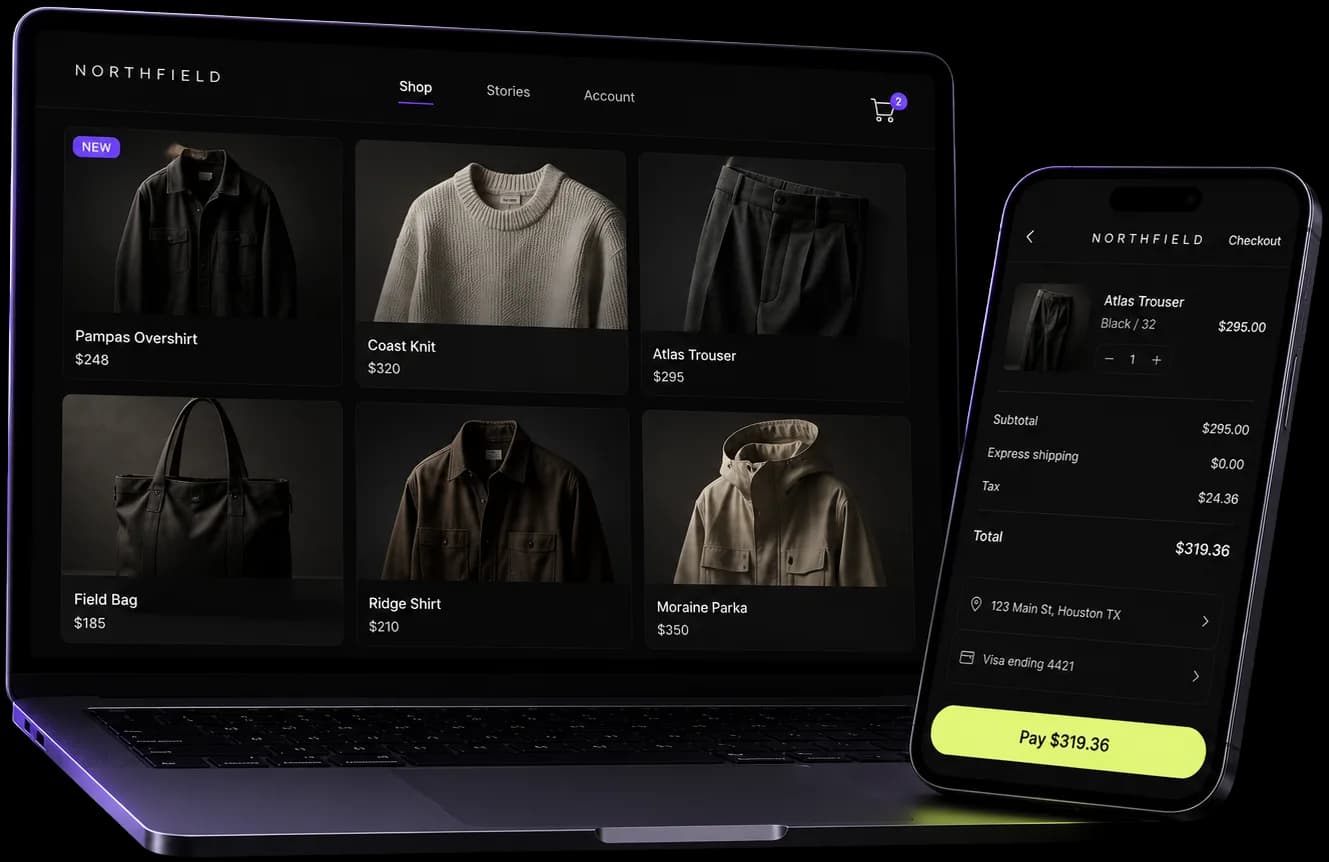
Single-brand DTC storefronts on Shopify Plus or headless (Next.js + Shopify / commercetools / Saleor) with custom-coded PDP, cart, and checkout — performance budget set on day one, conversion surfaces owned end-to-end.

Industries · E-commerce & Retail
From high-converting storefronts and headless commerce backends to mobile apps and order operations — IrenicTech builds custom e-commerce software designed for conversion, inventory, automation, and operational scale. One senior in-house team from first spec to production launch. Built for UAE and MENA teams, delivered from our Sharjah base.









The gap
The Shopify-plus-plugins stack works while the catalogue is small and the traffic is single-region. At ten thousand SKUs, two regions, and a mobile app on the roadmap it leaks margin, performance, and ops time. These are the patterns we hear from founders in every discovery call.
Theme-bound PDPs, carts, and checkouts limit what A/B testing can move. The brand looks the same as the next ten DTCs — and the conversion rate looks the same too.
Five SaaS add-ons each shipping their own JS, webhook, and update cadence. When one vendor changes their API your store goes dark, and the on-call team is your dev shop.
The store says in-stock, the warehouse says out, the marketplace shows yesterday's count. Returns and refunds compound the problem. Customers find out at checkout.
Render-blocking JS, three-step forms, and missing wallet integrations bleed a measurable percentage of cart value on every device. Mobile Lighthouse scores in the 40s.
Plugin-based 'related products' widgets recommend the obvious. AI tuned to your actual purchase patterns moves AOV and repeat-purchase rate; plugins move neither.
Fulfilment, returns, vendor purchase orders, and warehouse transfers live in tabs and email. Manual reconciliation eats finance team hours every week.
Looking for a specific capability? See all services we offer.
Custom vs template
Shopify templates with a stack of plugins get a brand to launch in weeks — and to a renewal-tax + plugin-conflict + page-weight wall by year two. Here is what a custom or headless build changes when revenue, catalogue, and channels start to scale.
Shopify template + plugins
IrenicTech custom
Conversion surfaces
PDP, cart, and checkout bound to a theme layout; A/B test scope limited to what the theme exposes
Custom-coded PDP, cart, and checkout with a real performance budget — every conversion surface owned end-to-end
Page performance
5–10 plugins each shipping their own JS, blocking the main thread; Lighthouse score in the 40s on mobile
Performance budget set on day one — render-blocking JS removed, image pipeline tuned, mobile LCP under 2.5s
Backend stability
Plugin sprawl — one vendor's update breaks another's webhook; the on-call team is your dev shop
Owned backend logic with retry queues, idempotent webhooks, and integration health monitoring
Mobile commerce
Responsive web view of the desktop store; install prompts via PWA at best
Native iOS and Android apps designed for repeat-purchase flow, with offline cart and push-driven re-engagement
Lock-in
Theme + plugin schema lives in the platform; switching means a full rebuild of every conversion surface
You own the repo, the product database, and every integration — exit cost is zero
Cost at scale
Platform tax + per-plugin fees + transaction fees that compound permanently as GMV grows
One-time build + fixed SLA — your infrastructure bill is predictable as the catalogue and order volume scale
What we build
Eight product categories covered by one senior team — from custom storefronts to marketplace platforms to headless commerce backends to AI recommendations. Every build is a custom e-commerce engagement, not a configured template.

Single-brand DTC storefronts on Shopify Plus or headless (Next.js + Shopify / commercetools / Saleor) with custom-coded PDP, cart, and checkout — performance budget set on day one, conversion surfaces owned end-to-end.
Multi-vendor marketplaces with seller onboarding, listing management, commission and payout logic, dispute workflows, and split-cart checkout across vendors.
Native iOS and Android shopping apps designed for repeat-purchase flow — offline cart, push-driven re-engagement, biometric login, and Apple Pay / Google Pay wallet integration.
API-first commerce architecture — Shopify Storefront API, commercetools, Saleor, or custom — with PIM, OMS, and a content layer (Sanity, Contentful) feeding any frontend you ship.
Custom OMS / WMS modules that unify orders across channels, sync inventory in real time, drive vendor purchase orders, and surface fulfilment and returns in one operator dashboard.
Stripe, Adyen, Braintree, Klarna, Afterpay, Apple Pay, Google Pay — wired into a checkout flow designed for conversion, with fraud, 3-D Secure, and tax engines built in.
Embeddings-backed product search and personalisation tuned to YOUR purchase patterns — cross-sell, upsell, predictive bundling, dynamic merchandising — designed for AOV and margin, not vanity metrics.
Workflow automation across ESP, CRM, ERP, shipping, accounting, and customer support — so the team that grows revenue stops being the team that copies orders between tabs.
Single-brand DTC storefronts on Shopify Plus or headless (Next.js + Shopify / commercetools / Saleor) with custom-coded PDP, cart, and checkout — performance budget set on day one, conversion surfaces owned end-to-end.
Multi-vendor marketplaces with seller onboarding, listing management, commission and payout logic, dispute workflows, and split-cart checkout across vendors.
Native iOS and Android shopping apps designed for repeat-purchase flow — offline cart, push-driven re-engagement, biometric login, and Apple Pay / Google Pay wallet integration.
API-first commerce architecture — Shopify Storefront API, commercetools, Saleor, or custom — with PIM, OMS, and a content layer (Sanity, Contentful) feeding any frontend you ship.
Custom OMS / WMS modules that unify orders across channels, sync inventory in real time, drive vendor purchase orders, and surface fulfilment and returns in one operator dashboard.
Stripe, Adyen, Braintree, Klarna, Afterpay, Apple Pay, Google Pay — wired into a checkout flow designed for conversion, with fraud, 3-D Secure, and tax engines built in.
Embeddings-backed product search and personalisation tuned to YOUR purchase patterns — cross-sell, upsell, predictive bundling, dynamic merchandising — designed for AOV and margin, not vanity metrics.
Workflow automation across ESP, CRM, ERP, shipping, accounting, and customer support — so the team that grows revenue stops being the team that copies orders between tabs.
Features that ship
Buyers, ops and fulfilment teams, and brand and revenue functions all have different jobs. Each surface is designed for the person actually using it — not a shared dashboard pretending to serve everyone.
For buyers
For ops & fulfilment
For brand & revenue
Case study
A DTC apparel brand (anonymised) · Full-stack platform — headless storefront, mobile apps, OMS, AI recommendations, and infrastructure
Problem
A DTC apparel brand running on a Shopify-plus-twelve-plugins stack hit a wall at $14M annual GMV: mobile Lighthouse score in the 40s, four plugin conflicts breaking checkout every quarter, inventory off-by-thousands across the warehouse, marketplace, and retail partner, and a 'related products' widget that recommended the same six SKUs to every shopper. The team had stopped shipping new conversion experiments because the theme could not absorb them.
Approach
IrenicTech designed and shipped the platform end-to-end — a headless storefront on Next.js + Shopify Storefront API, a custom-coded checkout with Stripe + Klarna + Apple Pay, native iOS and Android apps for repeat-purchase loyalty, an OMS unifying orders across Shopify, Amazon, and three retail partners, AI recommendations and visual search trained on the brand's actual purchase patterns, and a real-time inventory layer that surfaces stock across warehouses, marketplaces, and physical retail in one operator dashboard.
Outcome
Mobile Lighthouse score moved from 41 to 92. Conversion rate lifted 28% in the first quarter. AOV up 19% on the AI-recommended SKUs. Checkout abandonment cut by 22%. The brand scaled to multi-region (US, UK, EU) on the same codebase, without a rewrite, and the founding team owns the repo, the product database, and every integration outright.

AI-native
Every e-commerce product we ship gets the same AI lens, designed into the architecture from day one. These are the use cases we have shipped in production commerce environments — tuned for margin, not for vanity metrics.
01 · Use case
Cross-sell, upsell, and predictive bundling driven by embeddings on your real purchase history — moves average order value and repeat-purchase rate, not just clicks.
02 · Use case
Margin-aware price experimentation, predictive markdown timing, and personalised discount offers — grounded in inventory levels, sell-through velocity, and customer LTV.
03 · Use case
Demand-by-SKU forecasts, automated reorder triggers, and warehouse-balancing recommendations — so out-of-stock at checkout becomes an event, not a default state.
04 · Use case
Image-based and natural-language product search ('the linen shirt in the homepage hero'), grounded in your catalogue — for shoppers who do not know the product name.
05 · Use case
An in-store assistant that answers shipping, returns, sizing, and product-fit questions from your knowledge base and order history — deflecting tier-1 tickets without hallucinating.
06 · Use case
Behavioural and device signals fed into a model that flags risky orders before fulfilment — without rejecting good customers or burying ops in manual review.
These capabilities are available across all industries we build for. Explore our AI automation practice.
Security & compliance
PCI DSS, GDPR, CCPA, ePrivacy, sales tax engines, and WCAG accessibility built into the architecture, not added before an audit. Every release ships with the evidence trail already assembled.
PCI DSS
Cardholder data security across the checkout, payment processor, and order systems — tokenised processing, no raw card data in your environment, scope minimised by design.
GDPR
EU personal data handling for shopper, marketing, and order records — lawful-basis tracking, data residency controls, right-to-erasure workflows, and privacy-by-design architecture.
CCPA
California Consumer Privacy Act compliance: data inventory, opt-out flows, deletion rights, and disclosure obligations built into the customer data model.
SOC 2 Type II
Security, availability, processing integrity, confidentiality, and privacy controls with a full evidence trail — built into the platform from day one for enterprise procurement.
WCAG 2.1 AA / ADA
Accessibility built into the storefront UI — semantic HTML, keyboard navigation, screen-reader-friendly carts and checkouts. ADA lawsuits in US e-commerce are common; this is procurement insurance.
ISO 27001
Information security management system — risk assessments, controls, and continuous improvement aligned to the international standard.
ePrivacy & Cookie
EU ePrivacy Directive consent, cookie-banner UX, and consent-mode integration with analytics and ad pixels — implemented by default, not added before a regulator letter.
Sales Tax (VAT / GST / US)
Real-time tax calculation via Avalara, Stripe Tax, or TaxJar across VAT, GST, and US sales tax — destination-based, marketplace facilitator-aware, and audit-friendly.
PSD2 / SCA
Strong Customer Authentication built into every EU card transaction — 3-D Secure 2 flows, exemption logic, and frictionless authentication where the card network allows it.
BAA / DPA available on request — we carry our own agreements and sign yours.


How we work
DTC founders and retail operators want to know what month one looks like before committing. Here is the exact sequence from discovery sprint through production launch and steady-state SLA.
01
Audit the current stack, map buyer and ops journeys, set a performance budget, and scope the integration layer (PSP, OMS, ERP, ESP, shipping). Delivers a written architecture RFC and a fixed-scope estimate.
02
Headless or Shopify Plus decision, PIM and OMS architecture, payment and tax engine wiring, observability stack, and mobile-app strategy — all designed before a line of conversion code is written.
03
Custom-coded PDP, cart, and checkout shipped in tight 2-week sprints. Mobile apps, payment integrations, and AI recommendations land alongside core flows, not after.
04
Private beta to a percentage of traffic with full A/B test harness, daily conversion review, and rapid iteration — inside the same engineering team that built it.
05
Performance audit, security penetration test, PCI scope review, load testing for Black Friday, mobile app store launch, and feature expansion based on conversion signal.
06
Dedicated engineering team, 24/7 monitoring, incident response, peak-event readiness, and quarterly roadmap reviews — so the team that built it stays accountable for it.
Engagement models
Pick the shape that matches what you are scoping. Discovery sprints validate ideas. Dedicated teams ship roadmaps. Code-audit-and-takeover rescues stacks that outgrew their first build.
2–4 week fixed-scope sprint that delivers a working prototype, architecture RFC, and written estimate for the full build. Best for new e-commerce ideas that need a real artefact before committing budget.
Start this engagementA senior in-house pod (PM, designers, full-stack, AI, QA, DevOps) embedded with your team. Best for ongoing scope, multi-quarter roadmaps, or taking over from a stack that outgrew its first build.
Start this engagementInherit an existing Shopify, WooCommerce, or headless codebase, stabilise the highest-risk areas in the first sprint, then extend on a foundation you trust. Best for rescues, replatforms, and post-acquisition consolidation.
Start this engagementWhy IrenicTech
A senior in-house team that ships conversion-native by default, integrates AI from day one, and hands you the code on the first day.
PDP, cart, and checkout treated as first-class engineering surfaces with a real performance budget — not theme files you A/B test inside the limits of a layout.
AI tuned for AOV and repeat purchase, dynamic pricing, predictive inventory, fraud detection — designed to move unit economics, not vanity metrics.
No offshore intermediaries. The people scoping the work are the people shipping it — one team, one cadence, one codebase.
Every commerce product gets the same AI lens — recommendations, search, fraud, RAG-backed support — designed in from day one.
Repo, product database, customer data, and every integration live in your name from day one. No vendor lock-in, no licence fees, no exit cost.
Steady-state engineering, 24/7 monitoring, and peak-event readiness from the team that built it — so accountability doesn't end at handover.
FAQ
Templates and plugins ship fast but bound every conversion surface to a theme. A custom or headless build gives you a real performance budget, owned conversion code, and an integration layer that does not fall over when a plugin vendor changes their API. The shift usually starts paying back as soon as you hit serious traffic, multi-channel sales, or a mobile app.
All of the above. We pick the stack that fits the catalogue and the roadmap: Shopify or Shopify Plus where the platform earns its keep, headless on Next.js + Shopify Storefront API / commercetools / Saleor when conversion surfaces or backend complexity demand it, or fully custom when neither fits. The decision is part of the discovery sprint.
A focused MVP — custom storefront, checkout, payment integration, and basic OMS — typically takes 12–18 weeks from a locked spec. The discovery sprint (2–4 weeks before that) is where we harden the spec, set the performance budget, and lock the integration layer. A full multi-channel, multi-region platform with mobile apps and AI runs 22–32 weeks.
A lean MVP starts around $70–90k. A full-featured headless platform with mobile apps, OMS, payment processing, AI, and multi-region runs $150–250k and up, depending on scope. We scope everything transparently in the discovery sprint before any build commitment.
Yes. We integrate with Shopify, Amazon, eBay, NetSuite, SAP, Klaviyo, Mailchimp, Avalara, ShipStation, and any modern API. The integration layer is treated as production infrastructure with monitoring, retry logic, and idempotent webhooks — not a one-time wire-up that breaks every quarter.
Both. We ship native iOS and Android apps (React Native or Flutter) for repeat-purchase loyalty and push-driven re-engagement, alongside a responsive web storefront. Mobile is designed alongside the web build, not bolted on after.
We offer a post-launch SLA that keeps the team who built the platform accountable for it. That includes 24/7 monitoring, incident response, peak-event (Black Friday, holiday) readiness, performance optimisation, and quarterly roadmap sessions. You can also hand off to your in-house team — we document everything and run a structured knowledge transfer before we step back.
Start a conversation
Share the essentials and we’ll reply within 4 hours with a real next step, not an auto-responder.
What happens next
Other sectors

Sector
Gaming & Web3
Real shipped games, real on-chain economies.
Read sector page
Sector
SaaS & Startups
From MVP to multi-tenant, with AI at the core.
Read sector page
Sector
Healthcare
Software that takes the admin out of care.
Read sector page
Sector
Real Estate
Property data, turned into closed deals.
Read sector page
Sector
Fintech
Payments and dashboards, secured by design.
Read sector page