Mobile games
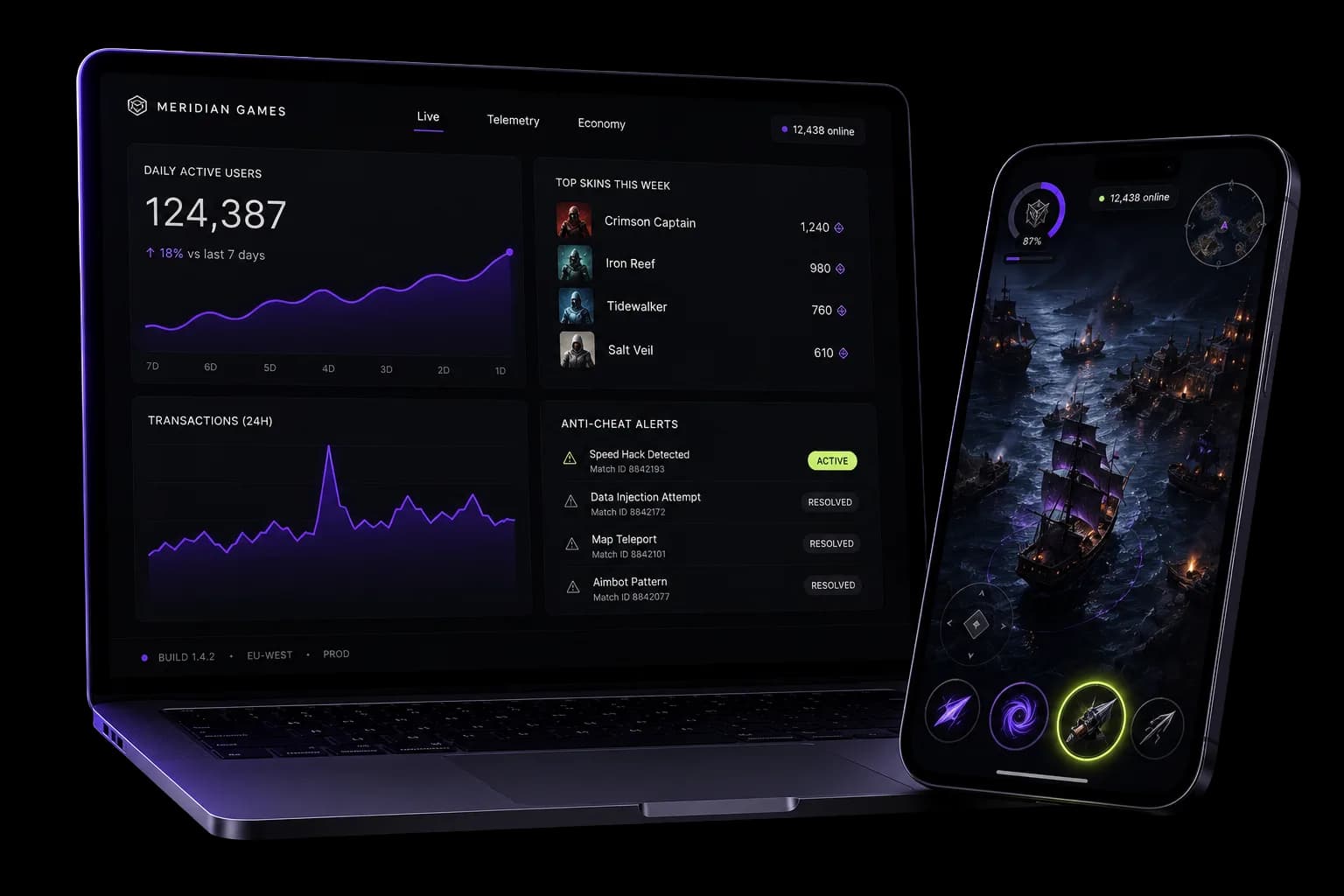
Native iOS and Android games — casual, mid-core, and live-service. Unity, Unreal, or React Native + native bridges where the game loop allows it.

Industries · Gaming & Web3
From shipped multiplayer games like Golden Tides (KRAFTON) to browser-native 3D experiences like Irenicverse and Storybook — IrenicTech builds custom games and Web3 platforms designed for real players, real economies, and production scale. One senior in-house team from first prototype to live ops. Built for UAE and MENA teams, delivered from our Sharjah base.









The gap
The studios we hear from in discovery calls fall into the same handful of failure patterns — polished games with token economies bolted on, chain-first projects with no players, asset-store backends that break at the first viral moment, and wallet prompts in the default flow that destroy install conversion. Here are the patterns we hear most often.
The game ships well; then the economy gets added in the final sprint and breaks within the first week of mainnet. Token sink/source curves were never simulated against the play pattern.
A contract ships, a whitepaper ships, a launchpad ships — but the game loop is two pages of design notes. Six months later there is a treasury and no daily active users.
The Unity asset store backend that worked for the closed beta starts billing per-CCU in production and breaks the unit economics at the first viral moment.
Cheating gets treated as a problem to solve after launch. By then the leaderboard is meaningless, retention is gone, and the economy is being farmed by bots.
First-time players hit a wallet connect, a gas estimate, and a signing modal before they have done anything fun. Conversion off the install drops by an order of magnitude.
Every player action costs an unknowable amount of gas. Cost-per-action is non-deterministic, ARPU is impossible to model, and the studio cannot plan against a number that drifts daily.
Looking for a specific capability? See all services we offer.
Custom vs template
Asset-store templates and NFT-template launchpads get a project to a demo fast — and to a server-cost, gas-economics, or live-ops wall by month three. Here is what a custom build changes when the game is meant to scale past a closed beta.
Unity asset + NFT template stack
IrenicTech custom
Economy design
Token-launch first, game loop bolted on afterwards; sink/source balance discovered live, in front of players
Economy modelled alongside the game loop as a system constraint from day one; sink/source curves simulated before mainnet
Server cost at scale
Asset-store backends with per-CCU pricing that breaks the unit economics at 10k concurrent users
Dedicated server architecture sized for the target CCU curve, with autoscale and regional sharding tuned to the actual play pattern
Anti-cheat
Generic anti-cheat plugin or none; cheating is treated as a post-launch problem
Authoritative server design, deterministic simulation where it matters, ML-based anomaly detection on the economy layer
On-chain UX
Wallet prompts in the default flow; players who don't know what gas is bounce on the first transaction
Custodial / non-custodial bridge with progressive disclosure — players who don't care about chain never see it; pros get full self-custody
Gas / fee economics
Players pay gas on every action; cost-per-action is unpredictable and breaks retention math
Layer-2 or sidechain settlement, gas sponsorship, batching, and meta-transactions so player-facing fees are stable and bounded
Post-launch live ops
Bug fixes are publisher-side, balance changes need a new contract deploy, telemetry is shipped after the fact
Live-ops dashboard from day one — balance levers tuneable without redeploy, telemetry streamed to the ops team, post-launch SLA in place
What we build
Eight product categories covered by one senior team — mobile games, browser 3D, narrative games, prototypes, NFT marketplaces, DApps, on-chain assets, and DAO tooling. Every build is a custom engagement, not a configured template.

Native iOS and Android games — casual, mid-core, and live-service. Unity, Unreal, or React Native + native bridges where the game loop allows it.
Browser-native 3D and 2D games with Three.js, Babylon, or Phaser. WebGL pipelines tuned for mid-range hardware. No install, full experience.
Story-driven and educational games — branching narrative, multi-scene pacing, guide characters, accessibility tuned for the audience age.
Vertical slices and playable prototypes for funding rounds, publisher pitches, and internal validation. Fast to a demo, real engineering underneath.
Custom marketplaces with order books, royalties, lazy minting, and the seller-side tooling real collectors and game studios actually use. Not a generic listing widget.
End-to-end DApps: Solidity / Rust contracts, frontend (React + wagmi / viem), audited deploy pipelines, monitoring and incident response.
ERC20 / ERC721 / ERC1155 contracts for in-game currency, skins, items, and tokenised real-world assets. Designed against a sink/source model, not just minted.
Governance contracts, proposal interfaces, treasury dashboards, and the off-chain workflow tooling DAOs need to actually run — not just vote.
Native iOS and Android games — casual, mid-core, and live-service. Unity, Unreal, or React Native + native bridges where the game loop allows it.
Browser-native 3D and 2D games with Three.js, Babylon, or Phaser. WebGL pipelines tuned for mid-range hardware. No install, full experience.
Story-driven and educational games — branching narrative, multi-scene pacing, guide characters, accessibility tuned for the audience age.
Vertical slices and playable prototypes for funding rounds, publisher pitches, and internal validation. Fast to a demo, real engineering underneath.
Custom marketplaces with order books, royalties, lazy minting, and the seller-side tooling real collectors and game studios actually use. Not a generic listing widget.
End-to-end DApps: Solidity / Rust contracts, frontend (React + wagmi / viem), audited deploy pipelines, monitoring and incident response.
ERC20 / ERC721 / ERC1155 contracts for in-game currency, skins, items, and tokenised real-world assets. Designed against a sink/source model, not just minted.
Governance contracts, proposal interfaces, treasury dashboards, and the off-chain workflow tooling DAOs need to actually run — not just vote.
Features that ship
Players, studios, and publishers / live-ops all have different jobs. Each surface is designed for the person actually using it — not a shared dashboard pretending to serve everyone.
For players
For studios
For publishers and live-ops
Case study
KRAFTON · Golden Tides · Web3 economy, in-game store, on-chain skin pipeline
Problem
Golden Tides is a real-time multiplayer combat game with a live, retention-driven economy. The publisher wanted to bring the asset economy on-chain — tokenised skins, ERC20-backed in-game currency, a marketplace — without breaking the existing game loop or shipping a UX that asked players to learn crypto.
Approach
We engineered the on-chain layer as a substrate, not a feature. An ERC20 contract for the in-game token, an ERC721 skin standard with off-chain metadata caching, an in-game store that hides wallet plumbing behind a familiar storefront UI, and a custodial / non-custodial bridge so players who do not care about chain can still trade. Real-time multiplayer kept its existing performance budget; the chain ran in the background.
Outcome
Players buy and trade skins like they would in any AAA game — no wallet prompt, no gas estimate, no signing modal in the default flow. The publisher gets a real asset economy with marketplace fees, royalties, and player-driven liquidity. Shipped with $10M+ in publisher-side engineering and live-ops investment behind it — production-scale, not a proof of concept.
Case study
Internal · IrenicTech showcase · Three.js design and build
Problem
Static portfolio pages all blur together. A 3D walkthrough makes a stronger impression — but only if it loads fast and the interactions feel meaningful, not gimmicky. Most browser-3D portfolios fail the first test and shrug at the second.
Approach
Built a Three.js storybook with a guide character, multi-scene narrative pacing, hand-tuned graphics for mid-range hardware, and navigation any first-time visitor can follow without a tutorial. The same browser-3D pipeline we recommend to clients, applied to our own surface.
Outcome
A browser-native interactive portfolio used as a leave-behind for client conversations — memorable, performant, and on-brand. Proof that we ship browser 3D the same way we ship native games.

Case study
Internal · IrenicTech showcase · Three.js design and build
Problem
A traditional careers and about page tells clients and recruits about the team. We wanted to show them — with the same browser-native, install-free approach we recommend to clients evaluating Web3 and game experiences.
Approach
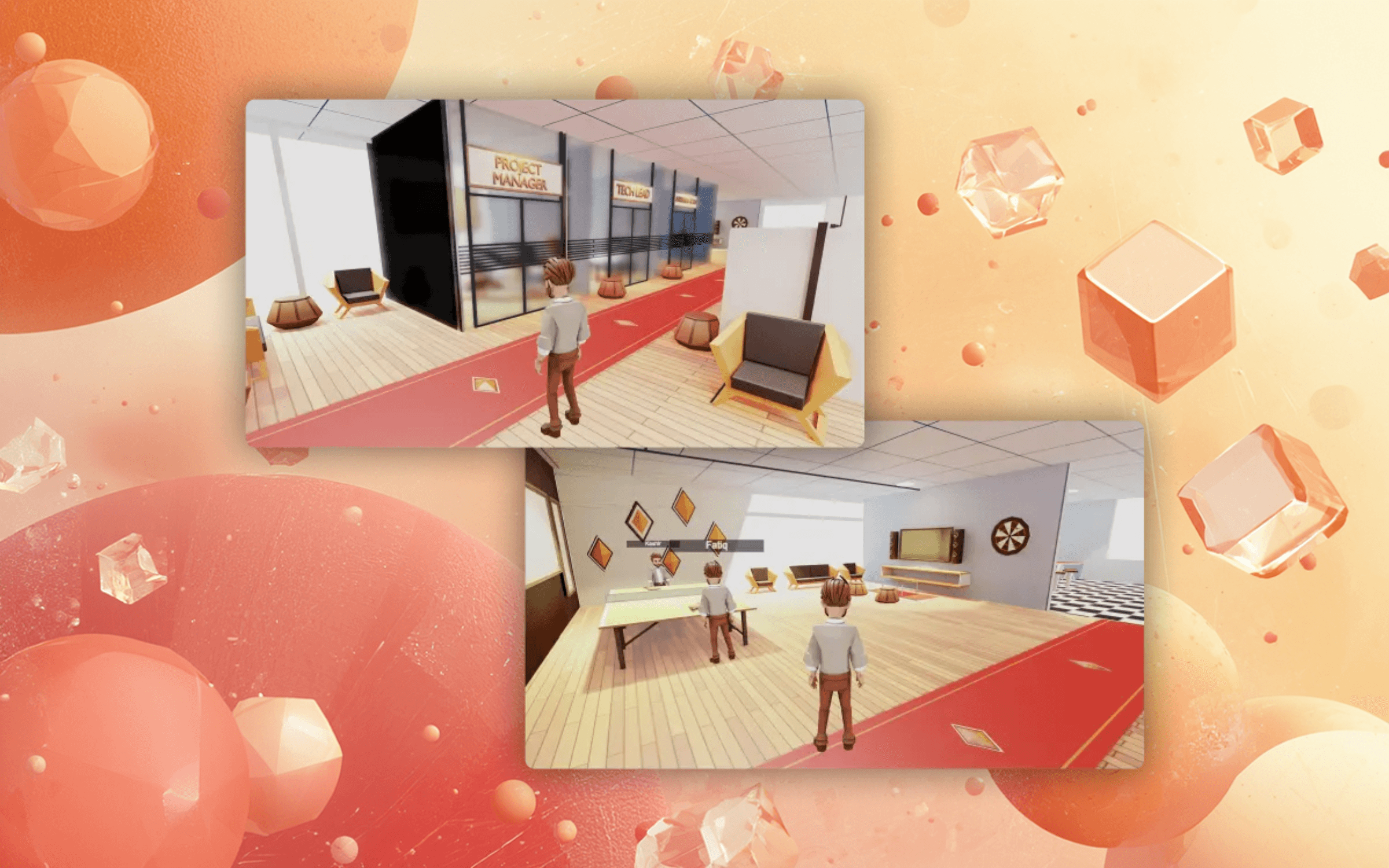
Built a navigable 3D office in Three.js, modelled meeting rooms and workstations, placed interactive avatars and project showcases throughout, and tuned the experience to load fast and run well on mid-range hardware. Same pipeline we use for game-world architecture, applied to a brand surface.
Outcome
A WebGL office anyone can visit in a browser — used by prospective clients to get a feel for how the team works without flying in. The Web3 / metaverse pattern, done as engineering and not as a press release.
AI-native
Every game we ship gets the same AI lens, designed into the architecture from day one. These are the use cases we have shipped in production — tuned for retention and economy health, not for vanity demos.
01 · Use case
Adaptive NPC dialog and behaviour trees that use small or medium LLMs to keep conversations fresh without breaking lore, with safety filters tuned to the audience rating.
02 · Use case
Levels, terrain, quests, and items generated against a designer-tuned constraint set — variety without losing the hand-of-the-author feel that templates always strip.
03 · Use case
Telemetry-driven difficulty curves, matchmaking ELO adjustments, and economy balance levers tuned automatically against retention and ARPU targets.
04 · Use case
Pattern recognition on the economy and gameplay telemetry streams that flags bots, exploit chains, and wash trading before they hit the leaderboard.
05 · Use case
Automated cohort analysis, funnel breakdowns, and churn prediction wired directly to the live-ops dashboard so the ops team acts on the signal, not on a weekly report.
06 · Use case
Texture variants, animation in-betweens, voice lines, and proc-gen variations generated through the asset pipeline with art-direction review baked into the workflow.
These capabilities are available across all industries we build for. Explore our AI automation practice.
Safety & compliance
COPPA, GDPR, ESRB, PEGI, App Store and Play Store policies, loot-box disclosure, AML / KYC, and Web3 securities review built into the architecture, not added before a regulator letter or a store rejection. Evidence trail assembled as the game is built.
COPPA
Children's Online Privacy Protection Rule compliance for games with under-13 audiences — verifiable parental consent, data minimisation, and the disclosure obligations baked into the onboarding flow.
GDPR
EU personal data handling for players, marketing, and economy records — lawful-basis tracking, data residency controls, right-to-erasure workflows, and privacy-by-design architecture.
ESRB rating
Entertainment Software Rating Board questionnaire support and content-tagging built into the publishing pipeline — the rating evidence is assembled as the game is built, not before a re-rating.
PEGI rating
Pan European Game Information rating workflow — content descriptors, age gating, and the regional restrictions that follow from the rating, wired into the storefront and onboarding.
Apple App Store policies
App Review Guidelines compliance — payment-flow restrictions, IDFA disclosures, kids-category rules, and the loot-box / random-reward disclosures Apple now enforces in-app.
Google Play policies
Developer Program Policies compliance — Real-Money Gambling and Contests rules, ads policy, Family Programme requirements, and the Play Store's gacha and loot-box disclosure obligations.
Loot box / gacha disclosure
Probability disclosure for randomised rewards across jurisdictions that mandate it (UK, Netherlands, Belgium, Australia, China) — the odds publish alongside the spin, not buried in patch notes.
AML / KYC (Web3)
Anti-money-laundering and know-your-customer flows for marketplaces, token sales, and DAOs operating in jurisdictions with MiCA (EU), BSA (US), or equivalent regimes — tiered KYC sized to the transaction volume.
Securities-law guidance (Web3)
Token classification review against Howey-style tests in the US and MiCA category mapping in the EU. We do not give legal advice — we build to a counsel-reviewed brief and document the design choices behind it.
BAA / DPA available on request — we carry our own agreements and sign yours.


How we work
Game studios and Web3 founders want to know what month one looks like before committing. Here is the exact sequence from discovery sprint through soft launch and steady-state live ops.
01
Game-design and economy review, target-audience workshop, regulatory pre-check. We leave with a one-page brief and a vertical-slice scope.
02
Playable prototype of the core loop, on-chain prototype of the economy contracts, asset-pipeline test. Investor-ready, not a tech demo.
03
Content sprints, art pipeline, smart-contract audit, server architecture, anti-cheat. Telemetry wired in from sprint one, not at launch.
04
Region-locked soft launch, telemetry-driven balance tuning, economy simulation against real player behaviour. Mainnet rehearsal happens here.
05
Cross-store release (App Store, Play Store, Steam, web), mainnet contract deploy, marketing-ops handover. Day-one live-ops on call.
06
24/7 monitoring, incident response, balance levers tuned without redeploys, quarterly roadmap reviews, and a documented hand-off path when you bring the game in-house.
Engagement models
Pick the shape that matches what you are scoping. Discovery sprints validate ideas. Dedicated teams ship roadmaps. Code-audit-and-takeover rescues games and Web3 stacks that outgrew their first build.
Two to four weeks, fixed scope. We validate the game design, prototype the economy, audit the regulatory landscape, and leave with an investor-ready brief and a vertical-slice plan.
Start this engagementA senior in-house team — engineers, designers, smart-contract authors, and live-ops — embedded as your studio for a fixed roadmap. You get a delivery lead, a weekly demo, and the code on day one.
Start this engagementFor studios with an existing game or Web3 stack that has outgrown its first build. We audit the contracts, the server architecture, and the economy, then rebuild the parts that broke first.
Start this engagementWhy IrenicTech
A senior in-house team that has shipped a KRAFTON-backed Web3 game, ships browser 3D as a default, integrates AI from day one, and hands you the code on the first day.
Golden Tides is live with a real on-chain economy, a custodial bridge, and a publisher-grade ops pipeline. We are not theorising about Web3 games; we have shipped one.
Irenicverse and Storybook are not side projects. Three.js and WebGL are part of the regular engineering practice, sized for mid-range hardware, used in production.
NPC behaviour, procedural content, dynamic difficulty, anti-cheat, and analytics get the AI lens at architecture time. AI is a design constraint, not a marketing line on the landing page.
Sink and source curves simulated against the play pattern before the contract is deployed. Token economies launch with a model behind them, not a press release.
The engineers in your discovery call are the engineers shipping your code. No staffing layer in between, no junior offshore handoff after kickoff.
We hand you the repository, the contracts, the deploy pipeline, and the runbooks from the first sprint. No proprietary platform you cannot leave.
FAQ
Both. We have shipped full game builds (Three.js / WebGL, mobile, native) and we have engineered the Web3 economy and in-game store on top of an existing game (Golden Tides). Pick the engagement shape that matches your need.
For native and mobile games: Unity, Unreal, Godot, and native Swift / Kotlin where the game loop demands it. For browser games: Three.js, Babylon.js, Phaser, PixiJS. For mobile cross-platform: React Native and Flutter where the game loop allows.
Ethereum, Polygon, Base, Arbitrum, Solana, and BNB Chain in production. We pick the chain on technical fit (cost per action, finality, ecosystem) and recommend a default for your specific game economy in the discovery sprint.
Layer-2 or sidechain settlement for the default flow, gas sponsorship for actions inside the game loop, meta-transactions where the contract surface allows, and batching for marketplace operations. Player-facing fees are stable and bounded; surprise gas prompts are a bug.
Yes. Authoritative server architecture for game state, deterministic simulation where it matters, and ML-based anomaly detection on the economy telemetry. We design anti-cheat into the architecture from sprint one; bolting it on after launch does not work.
We build, and we coordinate independent audits before mainnet. We do not market ourselves as an audit firm — that is a conflict of interest. The contracts we ship go to an external auditor (OpenZeppelin, Trail of Bits, or comparable) before deploy.
Discovery sprint: two to four weeks. Vertical slice: six to ten weeks. Production to soft launch: four to nine months depending on scope and content depth. Live ops: ongoing. Investors get a vertical-slice demo before production begins.
Fixed-scope for discovery and vertical slice; monthly retainer for dedicated team during production; SLA-based for post-launch live ops. Token revenue share is available for projects where IrenicTech is a co-development partner; this is negotiated case-by-case.
Start a conversation
Share the essentials and we’ll reply within 4 hours with a real next step, not an auto-responder.
What happens next
Other sectors

Sector
SaaS & Startups
From MVP to multi-tenant, with AI at the core.
Read sector page
Sector
Healthcare
Software that takes the admin out of care.
Read sector page
Sector
Real Estate
Property data, turned into closed deals.
Read sector page
Sector
Fintech
Payments and dashboards, secured by design.
Read sector page
Sector
E-commerce & Retail
Storefronts engineered for conversion.
Read sector page