The Costly Oversight in Multi-Tenant SaaS Architecture
Leaving tenant isolation for later is how SaaS startups end up paying for a $100K rewrite. Here's why we add row-level security from the first migration.
IrenicTech · · 2 min read
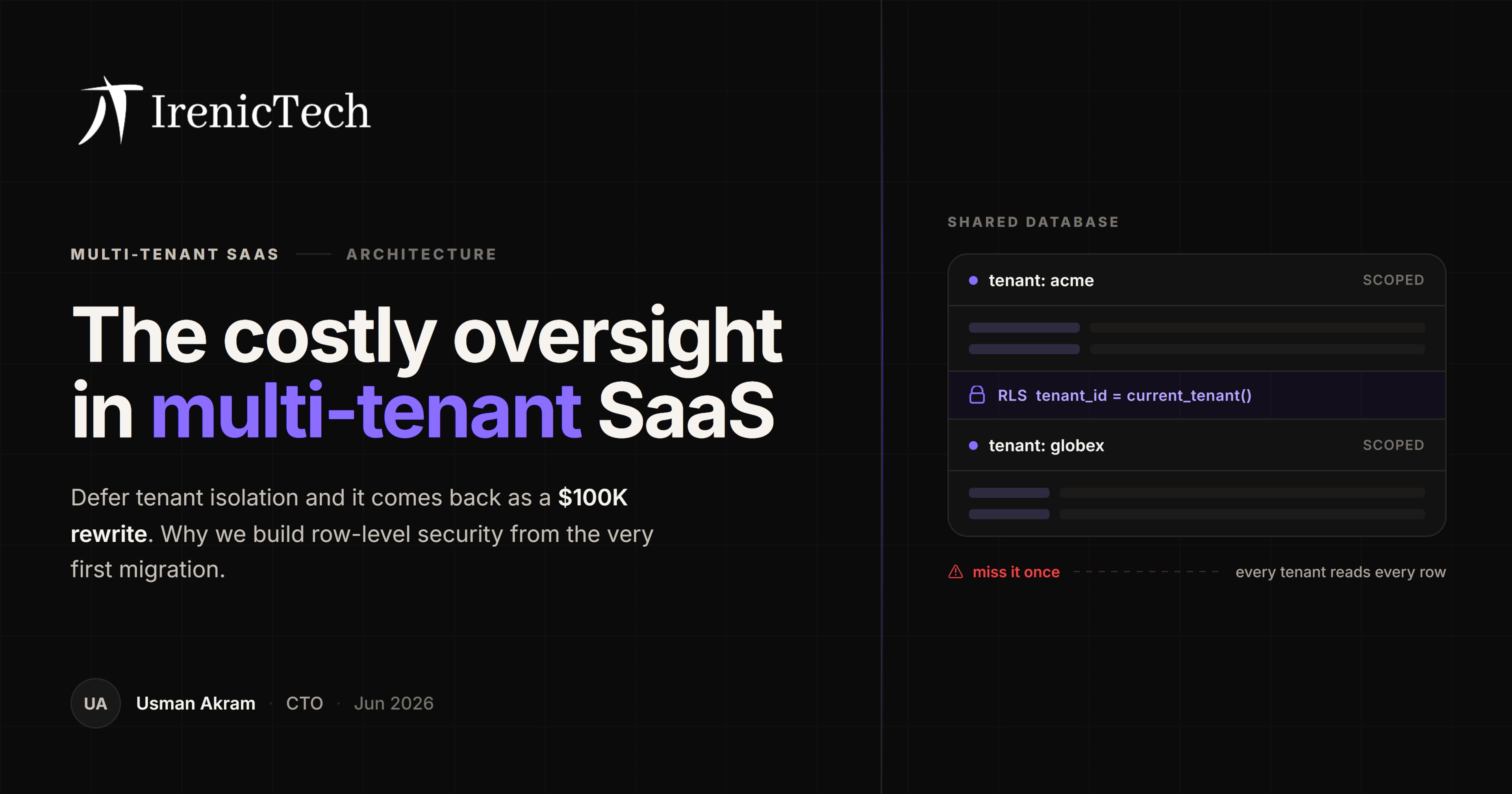
A lot of SaaS founders end up paying for a $100K rewrite because they left tenant isolation until later. We've watched it happen. A startup gets close to launch, lands its first enterprise prospect, and then finds out the data model can't keep one customer's data away from another's without tearing the whole thing apart. Row-level security (RLS) is cheap on day one and brutally expensive to bolt on at day 400.
Why is multi-tenant SaaS architecture so crucial in 2026?
Most B2B SaaS runs many customers on one shared database. That's fine, and usually the right call. The catch is that "shared" only stays safe if every query, every job, every middleware layer respects the same tenant boundary. Miss it in one place and one customer can see another's data. A single forgotten tenant_id is all it takes.
What's wrong with treating row-level security as optional?
Founders skip it because it feels like something you can add later. We've built three multi-tenant SaaS platforms in the last 18 months, and the pattern is always the same. Skip RLS up front and your tables fill with data that assumes no boundaries exist. By the time you need to add one, the boundary has to thread through every table, query, and background job you've written. That's not a feature you add. That's a rewrite.
How does skipping tenant isolation lead to a costly rewrite?
It usually surfaces at the worst time: an enterprise client asks how you isolate their data, and the honest answer is "we don't, yet." Now you're retrofitting isolation across a live codebase with real customers on it. We've seen that turn into a six-month project. Meanwhile the deal that triggered it is waiting, and your roadmap stops.
Where does shared-schema fit in modern SaaS?
Shared-schema with RLS is the right choice for maybe 80% of B2B SaaS, especially startups under $5M ARR. It's cheap to run and quick to ship. The one rule is consistency: auth, middleware, and background jobs all have to enforce the same tenant rule. Get that consistent from the start and shared-schema scales a long way. Let it drift and it becomes the trap everyone warned you about.
Can you plan for scale and compliance from day one?
Yes, and it's not much extra work if you do it first. We add RLS at the start of every project, so isolation is just how the database works rather than something we negotiate with later. That's also what makes a build compliance-ready when an investor or enterprise client starts asking, instead of a fire drill.
How does IrenicTech avoid these mistakes?
We build the boundary in before we write the features that depend on it. RLS from the first migration, enforced everywhere, so cross-tenant leaks aren't possible by construction rather than by remembering. It pays off in quieter ways too: integrations like Stripe get simpler when per-tenant tracking is already baked into the schema, because the structure assumed it from the start.
The common advice is to worry about multi-tenancy later. We disagree, and we've paid to learn why. Leave it for later and "later" tends to arrive as a rewrite.
If you're building something similar, reach out. We'd compare notes.
Frequently asked
What are the common mistakes in multi-tenant SaaS architecture?
The big one is treating tenant isolation as optional and adding row-level security later. By the time you need it, the data model assumes no boundaries exist, so adding one means a rewrite instead of a feature.
Why is row-level security essential in SaaS?
It keeps each tenant's data isolated at the database level, so a forgotten check in one query can't leak one customer's data to another. Building it in from the start also makes you compliance-ready before an enterprise client asks.
How can IrenicTech help with SaaS architecture?
We add RLS from the first migration and enforce it across auth, middleware, and background jobs, so isolation is how the database works rather than something retrofitted under deadline pressure.