Claude Fable 5: Anthropic's Most Capable Public Model Is Here
Anthropic's Claude Fable 5 is its most capable public model yet. Here's what shipped, the new fallback safeguards, pricing, and what it means if you're building AI products.
IrenicTech · · 3 min read
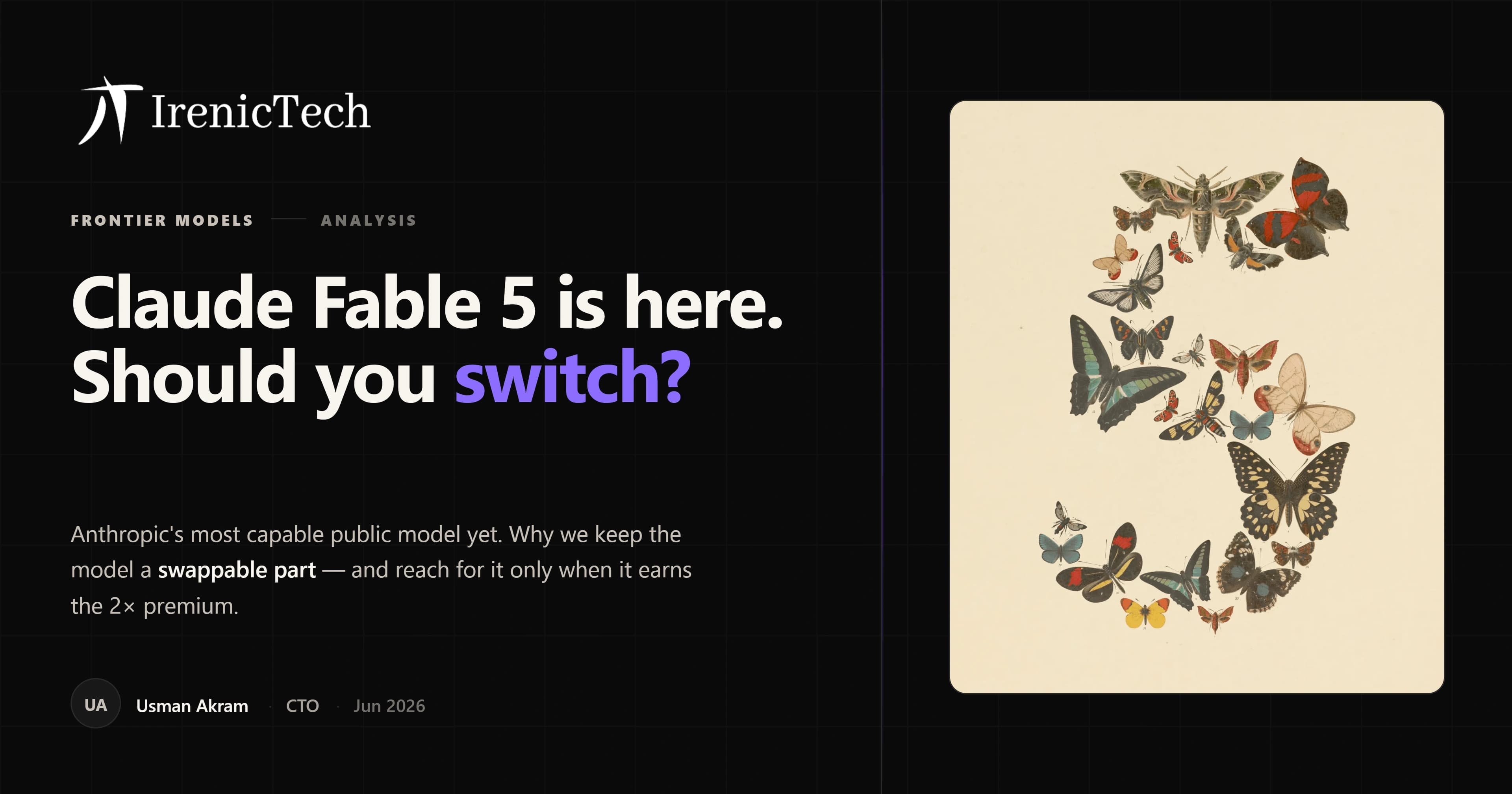
The morning Claude Fable 5 dropped, a client messaged us asking if they should swap their whole app over to it. We told them to wait a day and let us look. That reflex, where a new model means you rush to upgrade everything, is worth resisting, and this release is a good example of why.
Anthropic put Fable 5 out on June 9, 2026. It's the most capable model they've ever made publicly available, pulled from the "Mythos-class" tier they'd kept locked down until now. The capability is real. What you do about it is the part worth thinking through.
What actually shipped
Fable 5 sits above the Claude Opus 4.x family, with a 1-million-token context window. Anthropic built it for the work that's historically been hardest for models: long, multi-step tasks that run for many minutes and chain together dozens of tool calls.
The benchmark numbers back that up. It's the top scorer on FrontierBench, Cognition's frontier coding eval, and it's especially good at picking up unfamiliar tools without hand-holding. It's also the first model to crack 90% on Anthropic's internal benchmark for complex, long-running analytical tasks, about ten points clear of Opus. Across software engineering, vision, knowledge work, and scientific research, the story is the same.
One detail stood out to us more than the raw scores. Anthropic says the lead grows with task length and complexity. On short prompts the gap is modest. Hand it something that takes an hour and a lot of context, and the distance opens up. That's the kind of improvement that's hard to fake on a leaderboard, and the kind that actually shows up in agent work.
The part nobody else is leading with
Here's what makes this launch unusual. Fable 5 ships with a safety layer that quietly hands certain queries off to Claude Opus 4.8 instead, mostly in cybersecurity and biology. Anthropic says it kicks in on fewer than 5% of sessions on average.
That fallback is the whole reason a Mythos-class model could go public at all. For ordinary product work you'll never trip it. But if your app touches security tooling or anything life-sciences adjacent, file this away: a small slice of your responses may come from a different model than the one you asked for, and you won't get a flag saying so. Worth knowing before it surprises you in production.
For the cyberdefenders and infrastructure teams who do need the unguarded version, Anthropic also shipped Claude Mythos 5. Same model underneath, some safeguards lifted, limited access.
Availability and price
You can use Fable 5 today if you're an Anthropic enterprise customer or paid subscriber, and it's generally available in GitHub Copilot. Pricing is $10 per million input tokens and $50 per million output, roughly twice Opus 4.8.
That 2x is the catch. Fable 5 is the most capable thing on the menu. It is not the thing you should reach for by default.
So should you switch?
Mostly, no. Here's the call we gave that client, and the one we'd give you.
Keep your everyday workloads on Opus 4.8 or Sonnet: chat, extraction, RAG answers, routine tool calls. They're plenty capable, and you're not paying double for headroom you won't use. Save Fable 5 for the jobs where it earns the premium. Genuinely long-horizon agents. Gnarly analytical work. Anything where a model that can hold a thousand pages in its head and reason across all of it changes the outcome.
And don't mistake the model for the product. We've shipped enough AI features to be blunt about this. The base model is the part you have the least control over and the least edge in. Everyone gets the new model the same day you do. Your retrieval quality, your data, the evals you run before you trust an output: that's where the work actually lives, and it's why two teams on the same model ship wildly different products.
So build it so the model is a swappable part. When we wire up an AI system, the model sits behind a boundary with its own eval suite. The day something better lands, we run it against our own tests and decide in an afternoon instead of rewriting the app. Fable 5 is exactly the kind of release that setup is for. If switching to it is a project rather than a config change, the lesson isn't really about Fable 5. It's about the architecture.
Frequently asked
What is Claude Fable 5?
Claude Fable 5 is Anthropic's most capable publicly available model, released June 9, 2026. It is a Mythos-class model made safe for general use, with a 1M-token context window and state-of-the-art results across coding, reasoning, and long-horizon agentic tasks.
How much does Claude Fable 5 cost?
Pricing is $10 per million input tokens and $50 per million output tokens, roughly double Claude Opus 4.8. It is available to Anthropic's enterprise customers and paid subscribers, and is generally available in GitHub Copilot.
How is Claude Fable 5 different from Claude Opus 4.8?
Fable 5 is more capable, especially on long, complex, and agentic tasks, but costs about 2x more. It also ships with safeguards that route a small share of high-risk queries to Opus 4.8, so Opus remains the right default for most everyday production workloads.